

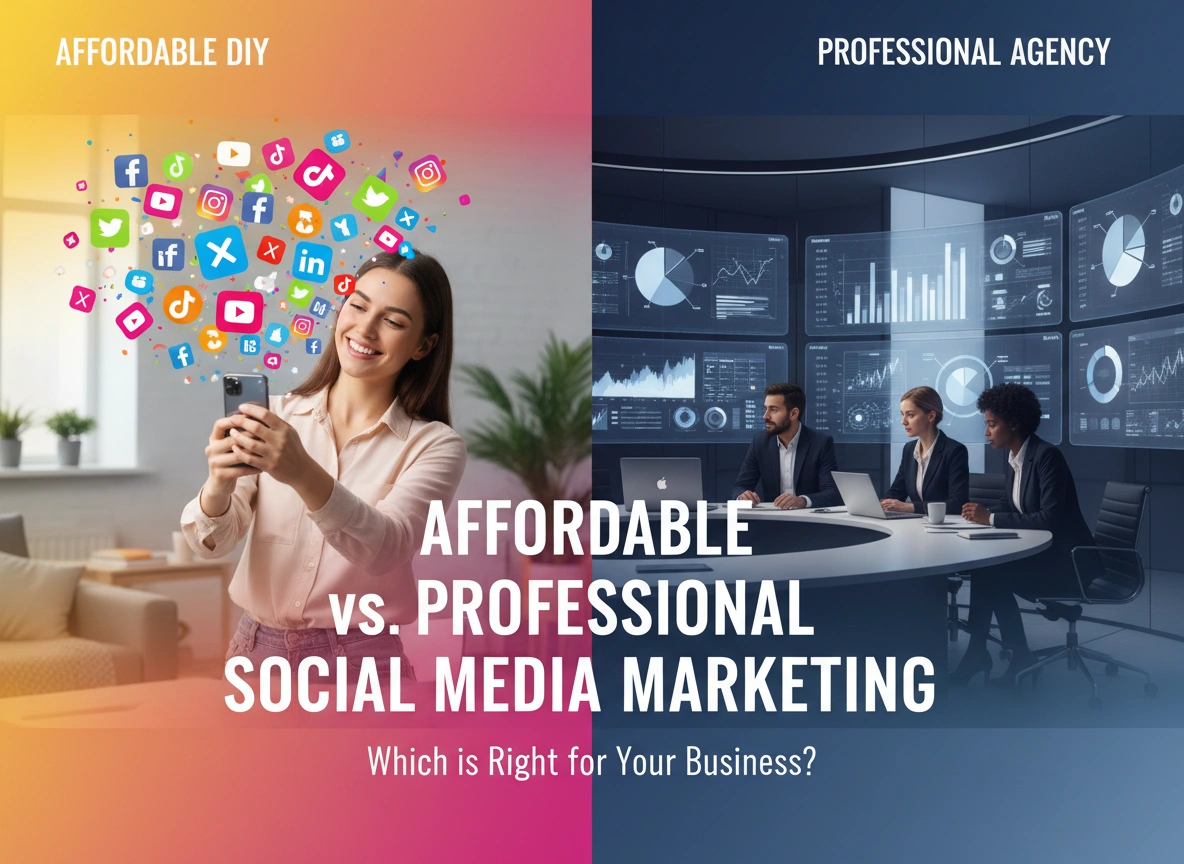
Every business owner eventually faces the same dilemma: “Do I handle my own social media on a budget, or do I invest in a professional agency?” It’s a valid question. The barrier to entry for social media is low—anyone can create a Facebook page or an Instagram account for free. However, the gap between having an account and actually growing a business through social media is massive.
Marketing budgets are often tight, especially for startups and small businesses. You might feel tempted to cut corners and go for the cheapest option available. Conversely, you might worry that “affordable” solutions will leave your brand looking amateurish. This article breaks down the real differences between affordable (often DIY or freelancer-based) and professional (agency or expert-led) social media marketing. By the end, you will have a clear framework to decide which path aligns with your current growth stage.
Defining the Contenders: Affordable vs. Professional
Before weighing the pros and cons, we need to clarify what we mean by these terms. They aren’t mutually exclusive—professional marketing can be affordable, and expensive marketing can be unprofessional—but in the general market, they represent two distinct service tiers.
What is Affordable Social Media Marketing?
“Affordable” marketing usually refers to cost-effective solutions designed to maintain a presence without breaking the bank. This often includes:
- DIY Approaches: The business owner or a junior staff member posts content sporadically.
- Budget Freelancers: Hiring someone on platforms like Upwork or Fiverr for $10-$20 per hour.
- Automated Tools: Relying heavily on AI generators or scheduling tools with minimal human oversight.
- Generalist Agencies: Firms that offer “social media packages” for a very low monthly flat fee (e.g., $200/month for 3 posts a week).
What is Professional Social Media Marketing?
“Professional” marketing focuses on strategy, ROI, and brand building. It involves experts who understand the nuances of algorithms, audience psychology, and data analysis. This tier typically includes:
- Specialized Agencies: Teams with dedicated copywriters, designers, and strategists.
- High-Level Consultants: experts who build comprehensive strategies for internal teams to execute.
- Full-Service Management: A hands-off approach for the business owner where the agency handles community management, content creation, ad spend, and reporting.
The Case for Affordable Social Media Marketing
There is a time and place for budget-friendly marketing. Not every business needs a Super Bowl-sized campaign strategy.
The Pros of Going Budget-Friendly
1. Lower Financial Risk
The most obvious benefit is cost. If you are a local bakery making $5,000 a month in profit, spending $3,000 on a social media agency doesn’t make mathematical sense. Affordable options allow you to test the waters without risking your operational cash flow.
2. Speed of Implementation
When you do it yourself or hire a quick freelancer, you avoid long onboarding processes. You can have a post up in ten minutes. Professional agencies often require strategy sessions, brand guideline reviews, and approval workflows before a single tweet goes live.
3. Authenticity
Sometimes, a raw, unpolished video shot on an iPhone by the business owner performs better than a slick, studio-produced commercial. Audiences on TikTok and Instagram Stories often crave authenticity. Affordable Social Media Marketing often defaults to this style out of necessity, which can accidentally align with current trends.
The Hidden Costs of “Cheap”
While the upfront price tag is low, affordable marketing often comes with hidden costs.
- Inconsistency: Without a dedicated team, posting often becomes sporadic.
- Generic Content: Low-cost providers often use stock photos and generic templates that fail to distinguish your brand.
- Lack of Strategy: Posting for the sake of posting rarely drives sales. Without a strategy, you are just making noise.
The Case for Professional Social Media Marketing
Professional marketing is an investment, not an expense. The goal here is to generate a return that exceeds the cost.
The Pros of Professional Management
1. Strategic Expertise
A professional team doesn’t just post; they plan. They analyze your competitors, identify your target demographic’s pain points, and build content pillars. According to a 2023 report by HubSpot, companies with a documented marketing strategy are 313% more likely to report success than those without one. Professionals bring that strategy to the table.
2. High-Quality Creative
Professional marketing provides access to skilled graphic designers, video editors, and copywriters. This ensures your brand looks polished and trustworthy. In an era where trust is the currency of sales, a pixelated logo or a typo-ridden caption can cost you a customer instantly.
3. Data-Driven Decisions
Professionals don’t guess; they test. They use advanced analytics tools to track engagement rates, click-through rates, and conversion costs. If a campaign isn’t working, they pivot. This agility saves money in the long run by ensuring ad spend isn’t wasted on ineffective audiences.
4. Comprehensive Community Management
Social media is a two-way street. It’s not just about broadcasting; it’s about responding. Professional agencies monitor comments and DMs, ensuring customer service issues are handled promptly. This builds loyalty and manages reputation risk.
The Cons of Going Pro
- Higher Cost: Quality costs money. Retainers can range from $2,000 to over $10,000 per month depending on the scope.
- Longer Setup Time: You cannot start tomorrow. Developing a robust strategy takes time and research.
Comparing ROI: The Metric That Matters
The decision ultimately comes down to Return on Investment (ROI).
Scenario A: The Affordable Path
You spend $300/month on a freelancer. They post generic motivational quotes. You get 10 likes per post but zero website clicks and zero new sales.
- Total Cost: $3,600/year.
- Revenue Generated: $0.
- ROI: Negative.
Scenario B: The Professional Path
You spend $3,000/month on an agency. They run targeted ads, create product demo videos, and engage with leads. This activity generates $15,000 in new sales per month.
- Total Cost: $36,000/year.
- Revenue Generated: $180,000/year.
- ROI: Positive and substantial.
This illustrates a critical point: Marketing that doesn’t work is expensive, no matter how cheap the price tag is.
Key Decision Factors: Which Path Should You Take?
So, how do you decide? Use these four factors to guide your choice.
1. Your Business Stage
- Startup / Solopreneur: If you are still validating your product and have limited cash, start with Affordable. Focus on being authentic and doing it yourself until you have revenue to reinvest.
- Scaling Business: If you have a proven product and steady revenue, you need to scale. This is the time to switch to Professional marketing to accelerate growth.
2. Your Goals
- Brand Awareness / Maintenance: If you just want a “pulse” so people know you are still in business when they look you up, a low-cost maintenance package is fine.
- Lead Generation / Sales: If you need social media to put money in the bank, you need a Professional strategy. Conversions require funnel building, retargeting, and persuasive copywriting.
3. Internal Bandwidth
Do you have time to manage a freelancer or create content yourself? If you are the CEO, your time might be worth $200/hour. Spending 10 hours a week on Instagram captions is a poor use of resources. Outsourcing to professionals buys back your time to focus on operations and high-level strategy.
4. Industry Competition
Look at your competitors. Are they posting high-quality video content and running sophisticated ad campaigns? If so, an amateur approach will make you look inferior by comparison. If your industry is slow to adopt social media, you might get away with a simpler approach for longer.
Bridging the Gap: The Hybrid Approach
You don’t always have to choose one extreme. Many successful businesses use a hybrid model.
For example, you might hire a professional consultant to build your quarterly strategy and create high-level templates (a one-time “Professional” cost). Then, you hire a junior marketing assistant or use an internal team member to execute that strategy day-to-day (an “Affordable” ongoing cost).
This approach gives you the strategic foundation of a pro with the execution costs of a budget option. It requires more oversight from you than a full-service agency, but significantly less effort than doing it all yourself.
Conclusion
The debate between affordable and professional social media marketing isn’t about which is “better” in a vacuum—it’s about which is better for you right now.
“Affordable” marketing is a valid entry point. It allows you to exist on social platforms without financial stress. However, it rarely drives significant growth. It is a maintenance tool.
“Professional” marketing is a growth engine. It requires capital, but it treats social media as a revenue stream rather than a chore.
Actionable Next Steps:
- Audit your last 3 months: How much time and money did you spend on social media? How much revenue can you directly attribute to it?
- Define your goal: Are you trying to maintain a presence or drive sales?
- Check your budget: Can you allocate 5-10% of your revenue to marketing? If that number allows for professional help, the ROI is usually worth it.
If you are serious about growth, stop looking for the cheapest option. Start looking for the option that offers the best performance. In the world of business, the most expensive marketing is the kind that doesn’t work.








Leave a Reply