
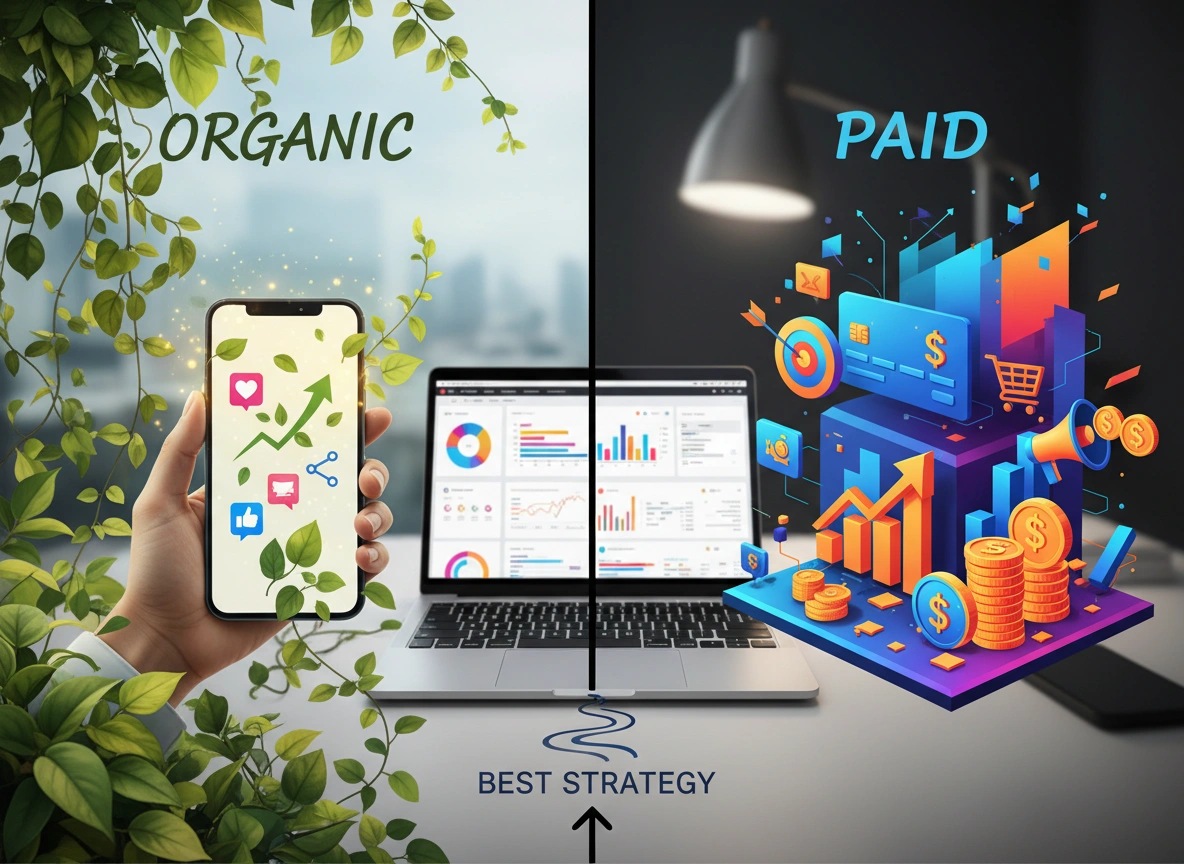
When you scroll through your favorite social media feed, you see two types of content. You see posts from friends or brands you follow because you enjoy their updates. Then, you see “Sponsored” posts that seem eerily tailored to the shoes you were just looking at online. This is the real-world battleground of organic versus paid social media marketing.
For business owners and marketers, deciding where to invest time and money can feel paralyzing. Should you focus on building a community slowly but authentically, or should you pay to get your message in front of the right people immediately? The answer is rarely black and white.
This guide breaks down the mechanics, benefits, and challenges of both strategies to help you decide which approach—or combination of approaches—will drive the best results for your specific goals.
What is Organic Social Media?
Organic Social Media Marketing refers to the free content (posts, photos, videos, memes, stories) that all users, including businesses, share on their feeds. When you post organically, you are speaking primarily to your existing audience—the people who have already chosen to follow you.
It is the foundation of your digital presence. Think of it as your brand’s personality. It’s how you nurture relationships, provide customer service, and establish your voice without a direct price tag attached to every impression.
The Core Benefits of Organic Marketing
1. Authentic Relationship Building
Organic content allows you to have a two-way conversation. When a customer comments on your post and you reply, you build trust. This authenticity is hard to buy. According to recent consumer surveys, a significant majority of consumers say they are more likely to buy from brands they follow on social channels.
2. Cost-Effectiveness
Posting is free. While it costs time and resources to create high-quality content, the actual distribution on the platform costs zero dollars. For startups or small businesses with tight budgets, organic social media is the most accessible marketing tool available.
3. Long-Term Brand Loyalty
Paid ads stop working the second you stop paying. Organic content builds a library of value that lives on your profile. Over time, consistent organic efforts create a loyal community of advocates who will defend your brand and recommend it to others.
The Challenges of Organic Reach
The biggest hurdle for organic marketing today is the algorithm. Platforms like Facebook, Instagram, and LinkedIn use complex algorithms to decide what users see. Over the last decade, organic reach (the percentage of your followers who actually see your posts) has plummeted.
For many brands on Facebook, organic reach hovers around 5% or less. This means if you have 10,000 followers, fewer than 500 might see your post unless it sparks significant engagement. Relying solely on organic means you are at the mercy of platform updates that often deprioritize business content in favor of content from friends and family.
What is Paid Social Media?
Paid social media involves spending money to have your content shared with specific new audiences who are likely to be interested in your product or service. This includes “boosted” posts, display ads, sponsored stories, and video ads.
Unlike organic, where you hope the algorithm favors you, paid social allows you to bypass the line. You are paying for guaranteed placement in a user’s feed.
The Core Benefits of Paid Marketing
1. Precise Targeting
This is the superpower of paid social. You aren’t just shouting into the void; you are whispering directly to your ideal customer. Platforms allow you to target based on:
- Demographics: Age, gender, location, income.
- Interests: Hobbies, favorite brands, media consumption.
- Behavior: Past purchases, device usage.
- Lookalike Audiences: Finding new people who share characteristics with your best existing customers.
2. Immediate Results
Organic growth is a marathon; paid social is a sprint. If you launch a new product today, you can start driving traffic to your website within hours using paid ads. This speed is critical for time-sensitive campaigns, holiday sales, or lead generation drives.
3. Scalability
If an ad campaign is working—meaning you put in $1 and get $3 back—you can scale it instantly. You simply increase your budget to reach more people. Organic content doesn’t scale linearly in the same way; a viral post is great, but you can’t pay to make it go viral again on demand.
The Challenges of Paid Advertising
The obvious barrier is cost. In competitive industries, the cost-per-click (CPC) can be high. If you don’t manage your campaigns carefully, you can burn through a marketing budget quickly with little return on investment (ROI).
Furthermore, consumers are savvy. They know when they are being sold to. Ad fatigue—where users get tired of seeing the same ad—sets in quickly. Successful paid campaigns require constant monitoring, A/B testing, and creative refreshing to stay effective.
Comparing the Strategies: A Quick Breakdown
To visualize the differences, let’s look at how they stack up in key areas:
|
Feature |
Organic Social |
Paid Social |
|---|---|---|
|
Cost |
Time & Creativity (Free distribution) |
Monetary Budget |
|
Speed |
Slow build |
Instant impact |
|
Reach |
Limited to followers & viral reach |
Unlimited (based on budget) |
|
Targeting |
Very limited |
Highly specific |
|
Goal |
Brand awareness, loyalty, retention |
Leads, sales, conversion |
|
Lifespan |
Long-term value |
Ends when budget runs out |
Which Strategy Should You Choose?
The “Organic vs. Paid” debate is largely a false dichotomy. For most modern businesses, the answer isn’t “either/or”—it is “both.” They serve different stages of the marketing funnel.
When to Prioritize Organic
You should lean heavily into organic social media if your primary goals are:
- Brand Awareness & Reputation: You want to establish yourself as a thought leader.
- Customer Retention: You want to keep existing customers engaged so they buy again.
- Community Management: You need a channel to answer questions and manage service issues.
Example: A local coffee shop posts daily photos of their latte art and features staff members. This keeps their regulars engaged and reminds them to stop by. They don’t need to pay for ads to reach the people who walk past their shop every day.
When to Prioritize Paid
You should allocate budget to paid social if you need:
- Lead Generation: You need to capture emails or get sign-ups now.
- Sales Conversion: You have a specific product launch and need to drive direct purchases.
- Retargeting: You want to reach people who visited your website but left without buying.
Example: An e-commerce brand selling ergonomic office chairs launches a new model. They use paid ads to target people aged 25-45 who have expressed interest in “remote work” and “home office setups.” This puts the product directly in front of buyers ready to purchase.
The Hybrid Approach: The Sweet Spot
The most successful brands use a hybrid strategy. They use organic content to build a brand identity and test what resonates, and then use paid ads to amplify their best successes.
Here is a practical framework for combining them:
1. Test with Organic
Post your content organically first. Monitor your analytics. Which posts are getting the most likes, comments, and shares? This data is free market research.
2. Boost the Winners
Take your top-performing organic posts and put money behind them. Since you already know the creative resonates with your audience, it is much more likely to perform well as an ad to a colder audience. This lowers your risk of wasting ad spend on ineffective content.
3. Use Paid to Feed Organic
Run ads with the goal of “Page Likes” or “Follows” to bring new people into your ecosystem. Once they follow you, your organic content takes over to nurture them into loyal customers.
4. The Retargeting Loop
Use organic content to drive traffic to your website (e.g., a blog post link). Then, use paid tracking pixels to “retarget” those visitors with product ads later. This is highly effective because you are advertising to people who already know who you are.
Key Metrics to Watch
Regardless of the mix you choose, you must measure success.
For Organic: Focus on Engagement Rate. Are people caring about what you post? Look at comments and shares, not just vanity metrics like follower count.
For Paid: Focus on Cost Per Acquisition (CPA) and Return on Ad Spend (ROAS). Are you making more money than you are spending? If your ROAS is positive, your paid strategy is working.
Conclusion
The landscape of social media marketing is crowded. Organic reach is harder to earn, and paid attention is more expensive to buy. However, by understanding the distinct roles each plays, you can build a robust strategy.
Use organic social to find your voice and build your tribe. Use paid social to find your buyers and scale your growth. By integrating both, you ensure that you aren’t just shouting into a void, but starting conversations that lead to conversions.
Start by auditing your current efforts. Are you spending hours on organic posts that no one sees? Or are you throwing money at ads that lead to a dead social profile? Adjust your balance, test your content, and let the data guide your next move.





Leave a Reply