

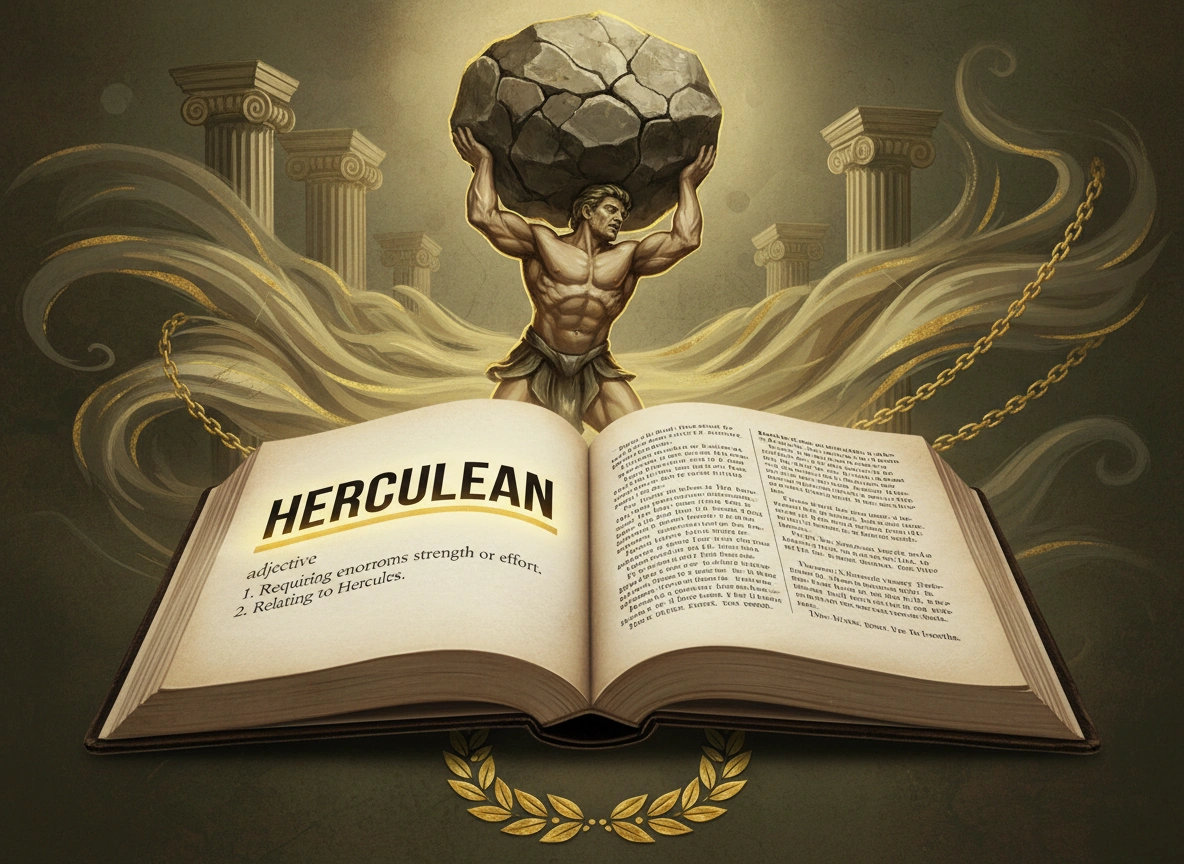
Language is rarely static. It breathes, evolves, and carries the weight of history in its syllables. Some words are purely functional, serving as simple connectors or descriptors. Others are architectural, building complex ideas. Then there are words that act as monuments—terms so steeped in narrative and cultural memory that using them invokes an entire mythology. “Herculean” is one such monument.
When we describe a task as Herculean, we are doing more than calling it difficult. We are summoning the ghost of an ancient hero, invoking the scale of gods and monsters, and suggesting that the effort required borders on the supernatural. Understanding the depth of this word, from its mythological roots to its modern applications, allows us to wield it with precision and power.
The Etymological Roots: From Heracles to Hercules
To truly understand the word “Herculean,” we must look back to the hero who gave it his name. The term is an eponym, derived from Hercules, the Roman adaptation of the Greek divine hero Heracles.
In Greek mythology, Heracles was the son of Zeus and the mortal woman Alcmene. His name, ironically, means “glory of Hera,” despite the fact that Hera, Zeus’s wife, despised him as a living reminder of her husband’s infidelity. It was Hera’s wrath that drove the narrative of his life, pushing him into the situations that would eventually define his legacy.
The suffix “-ean” (or “-ian”) in English denotes “relating to” or “resembling.” Therefore, in a strictly literal sense, Herculean means “relating to Hercules.” However, etymology is rarely just about literal translation. It is about the accumulation of meaning over centuries. The word entered the English language in the early 17th century, a time when classical education was paramount. Writers and orators needed a term that went beyond “hard” or “strenuous.” They needed a word that captured the magnitude of effort that seemed beyond human capacity.
The Twelve Labors: The Blueprint for Meaning
The core definition of Herculean—requiring great strength or effort—is directly tethered to the myth of the Twelve Labors. According to legend, Heracles was driven mad by Hera and killed his own children. To atone for this crime, he was ordered to serve King Eurystheus for twelve years. The king, guided by Hera, assigned him twelve tasks designed to be impossible.
These were not standard chores. He had to slay the Nemean Lion, whose hide was impenetrable to weapons. He had to clean the Augean stables, which housed thousands of immortal cattle and hadn’t been cleaned in thirty years, in a single day. He had to steal the golden apples of the Hesperides and capture the three-headed guard dog of the Underworld, Cerberus, without using weapons.
When we use the word “Herculean” today, we are referencing this specific scale of difficulty. A Herculean task is not just hard; it is theoretically impossible for the average person. It requires ingenuity, immense physical power, and an unyielding will.
For instance, cleaning the Augean stables wasn’t just about shoveling manure; Heracles rerouted two rivers to wash the filth away. This adds a layer of nuance to the word: a Herculean effort often implies a need for radical, outside-the-box thinking combined with brute force.
Evolution in Modern Language
Over time, the word has drifted from its purely mythological anchor to become a versatile adjective in modern English. While it still retains the flavor of ancient strength, its application has broadened significantly.
In contemporary usage, “Herculean” generally falls into two categories:
- Describing a Task: Referring to an undertaking that is exceptionally difficult, laborious, or time-consuming.
- Describing a Person or Attribute: Referring to someone who possesses immense physical size, power, or muscular build.
Interestingly, the word has shed some of the tragic context of the original myth. We rarely think of atonement or madness when we use it. Instead, it has become a superlative for effort and achievement. It transforms a struggle into something noble. If you say a team faced “difficult challenges,” it sounds like a complaint. If you say they faced “Herculean challenges,” it sounds like a heroic saga.
Usage in Diverse Contexts
The versatility of “Herculean” allows it to function effectively across various domains, from the boardroom to the bookshelf.
In Literature and Journalism
Writers love this word because it adds immediate dramatic weight. In political journalism, you might read about a candidate facing a “Herculean task” to win over a specific demographic. This implies the odds are stacked against them, much like the odds against Hercules facing the Hydra.
In literature, it is often used to describe physical characteristics. A character might possess a “Herculean frame,” instantly painting a picture of someone broad-shouldered, powerful, and intimidating. It saves the writer from listing measurements or muscle groups; the single word conveys the entire image.
In Business and Project Management
In the corporate world, “Herculean” is often used to describe logistics, turnarounds, and deadlines.
- Example: “The IT department made a Herculean effort to migrate the entire database over the weekend without any downtime.”
Here, the word acknowledges the extraordinary stress and workload involved. It validates the employees’ struggle and elevates their success. It suggests that what they achieved was not standard operating procedure, but something exceptional.
In Everyday Speech
While it is a somewhat elevated word, it finds its way into casual conversation when hyperbole is needed.
- Example: “Getting my toddler to eat vegetables is a Herculean struggle.”
This usage is slightly ironic. By juxtaposing a domestic frustration with a legendary hero’s trials, the speaker adds humor and emphasizes their exhaustion.
The Nuance of Strength vs. Difficulty
It is important to distinguish between the two primary uses of the word to communicate effectively.
If you describe a person as Herculean, you are almost always complimenting their physical stature or strength. “The linebacker has a Herculean build.”
However, if you describe a situation as Herculean, the connotation can be mixed. A Herculean task is impressive to complete, but it is terrible to endure. It implies a burden. Therefore, telling an employee “I have a Herculean project for you” might not be received as good news—it sounds exhausting before it has even begun.
Furthermore, there is a subtle difference between “Herculean” and similar words like “Sisyphean.” Both come from Greek mythology and denote extreme difficulty. However, a Herculean task is finite and conquerable—Hercules eventually finished his labors and was granted immortality. A Sisyphean task (from Sisyphus, who was condemned to roll a boulder up a hill for eternity only to have it roll back down) is endless and futile.
Choosing the right word matters. If a project is hard but achievable, it is Herculean. If it is hard and pointless, it is Sisyphean.
Why Vocabulary Matters: Precision in Expression
Why does it matter if we know the backstory of a word like Herculean? Why not just say “very hard”?
Expanding our vocabulary with words rich in history enhances our ability to communicate nuance. “Very hard” is subjective and flat. It tells us the level of difficulty but nothing about the nature of that difficulty. “Herculean” tells a story. It implies that the challenge requires courage, endurance, and perhaps a bit of divine luck.
When leaders use precise language, they inspire confidence. A CEO who acknowledges that a company turnaround will be “Herculean” is being honest about the scale of the problem while subtly suggesting that the team has the heroic capacity to solve it. It frames the struggle as a narrative of triumph waiting to happen.
Moreover, understanding these words connects us to our cultural heritage. It reminds us that human struggles—against nature, against difficult bosses, against our own limitations—have remained largely the same for thousands of years. We are still fighting Nemean Lions, even if they now look like impossible quarterly targets or complex coding bugs.
Conclusion
The word “Herculean” is a linguistic bridge spanning thousands of years. It connects the clay tablets of ancient Greece to the digital tablets of the modern boardroom. It captures the essence of human struggle and the glory of overcoming impossible odds.
To use the word is to pay homage to the idea that we are capable of more than we think. Whether we are describing a physical feat, a complex project, or a personal struggle, invoking the Herculean reminds us that difficulty is not a stop sign—it is a call to action. It is a reminder that with enough strength, wit, and persistence, even the most impossible stables can be swept clean. In a world often defined by quick fixes and shortcuts, the concept of the Herculean stands as a testament to the enduring value of hard, transformative work.Visit here to explore more details.
You may also read: Exploring Moral Dilemmas: Real-Life Examples and How to Navigate Them













Leave a Reply